Summary - Animal health: Towards a more resilient and sustainable future for Europe
Introduction
This report provides a quantitative analysis of sustainability-related benefits of strong animal health performance in Europe, examining associations between health, productivity and sustainability from three case studies in selected animal species and countries in Europe. The analysis was carried out by Oxford Analytica, a leading research and analysis firm, which developed a unique regression model to measure different animal health indicators.

The three case studies included in this report calculate estimates that show associations between improved livestock health and production, efficiency and sustainability outcomes. The findings point to how strong animal health performance benefits Europe’s commitment to ensuring food security and affordability, promoting resilience and sustainability within its agricultural economy, in line with shared climate objectives.
Key findings
Key findings from the case studies include calculated estimates on the reduction of production from an additional outbreak of disease, livestock savings from higher vaccination rates and the impact of disease on production efficiency and emissions. Oxford Analytica’s modelling indicates that:
For Germany, in the case of porcine reproductive and respiratory syndrome (PRRS) in pigs:
- Increasing pig vaccination rate by 20% → 11% reduction in livestock deaths.
- That’s 65.6 million servings of pork saved, and 21.9 million Kg of feed not wasted.
For the UK, in the case of a foot-and-mouth disease (FMD) outbreak in the national dairy cattle:
- Returning to a non-infected status from a low infected status→ an increase of 25,000 litres of milk.
- With higher disease levels meaning less efficient production, this change in disease status is equal to an emissions reduction of 36 million kg CO2-e.
For France, in the case of highly pathogenic avian influenza (HPAI) in poultry:
- Increasing the vaccination rate by 10% → 16 million meals saved.
- That’s EUR 5.5 million in financial savings, and 5 million Kg of feed not wasted.
Methodology
Estimates are produced for three case studies, measuring the impact of a specified disease on a species in a selected country. The report findings are derived from estimated calculations, with assumptions derived from regression models and credible sources identified by an expert network. Official databases, the World Organisation for Animal Health’s (WOAH) WAHIS platform and the European Union’s Eurostat database, are used to contextualise these estimates to specific diseases, species, or regions.
Reducing disease prevalence to promote efficient resource use
Controlling common diseases found in pigs, such as porcine reproductive and respiratory syndrome (PRRS) is key to efficient resource use and sustainability objectives.
- According to Oxford Analytica’s regression model, an additional case of any disease in pig herds is associated with a decline of 985 Kg in domestic pigmeat production in the following year.
- In the past decade, the estimated cumulative losses in pigmeat production due to an additional outbreak of PRRS in Europe amount to 91,000 tonnes.

Oxford Analytica analysed an increasing vaccination rate scenario for Germany and estimates a reduction in loss of livestock. The model finds that higher vaccination rates are associated with a lower estimated loss of livestock and reduced feed wasted.
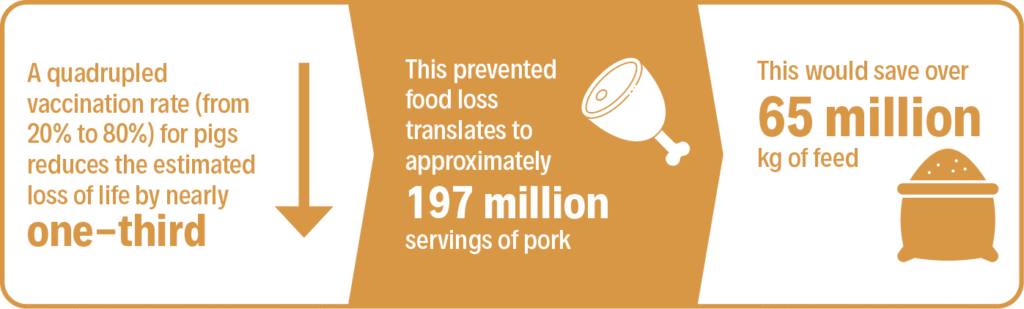
- When quadrupling the vaccination rate for pigs from a baseline vaccination rate of 20% to 80%, the estimated loss of livestock is reduced by nearly one-third.
- This prevented food loss translates to approximately 197 million servings of pork, or the ability to provide every resident in Germany (84 million people) a serving of pork at least twice.
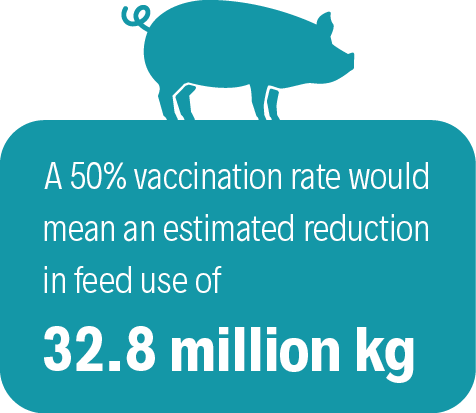
In the scenario of increasing the vaccination rate, there are also considerable savings in feed and land resources, typically wasted when pigs die prematurely.
- Assuming that each pig consumes approximately 255 Kg of feed in their life cycle, increasing the vaccination rate in the German swine herd by 20% would save an estimated over 21 million Kg of feed.
- Similarly, assuming that each pig requires about 0.83 square metres of land in Germany, increasing the vaccination rate by 40% would save more than 70 million square metres of land. This is equivalent to nearly a third of the entire city of Frankfurt, or half of the city of Brussels.
Improving health to reduce GHG emissions
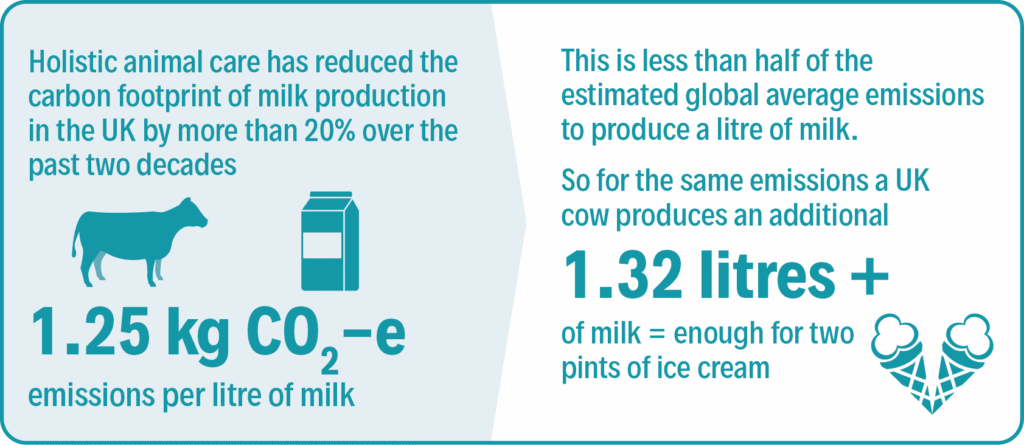
Improved health outcomes for the United Kingdom’s cattle sector, where beef and dairy products contribute the most value to the agriculture economy, is also key to minimising environmental impact, through reduced GHG emissions and efficient land use.
Oxford Analytica modelled a disease prevalence scenario on milk production, estimating impact on milk yield and the corresponding emissions that would have been generated by a change from no disease presence to a low or high rate of FMD infection outbreak in the 2024 UK dairy cattle population.

- If the UK Dairy Herd experienced a ‘low prevalence’ outbreak of FMD that led to 5% disease prevalence amongst dairy cattle, eliminating the disease (i.e. returning to 0% prevalence) would result in a 1.11% decrease in CO2-e emissions per litre of milk yielded.
- In a ‘high-prevalence’ outbreak of FMD that would lead to a 45% prevalence amongst dairy cattle, eliminating the disease would result in a 10% decrease in CO2-e emissions per litre of milk yielded.
When assessing the negative impact of disease in animal populations on GHG emissions release, the prevalence of the disease is a primary factor, alongside severity.
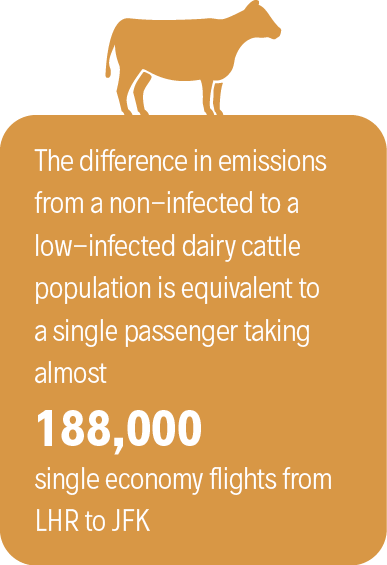
- If the UK were to move from a non-infected to a low-infected population, the model estimates a decrease in milk yield production by 1.2% which is equal to the loss of an estimated 25 thousand litres of Fat-and-Protein-Corrected-Milk (FPCM).
- A low infection scenario estimates around a 1.11% increase in GHG emissions per Kg of milk, equivalent to an estimated 36 thousand Kg of CO2-e.
Preventing disease outbreaks to reduce food losses
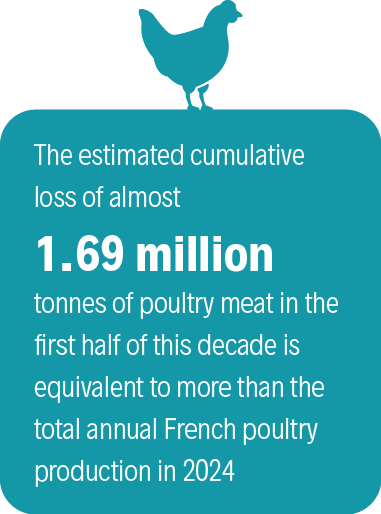
WOAH reports that HPAI has led to losses of over 547 million poultry worldwide between 2005 and 2023. In 2022 alone, 146 million birds were lost during an unprecedented peak.
- According to Oxford Analytica’s regression model a decline in poultry meat production due to HPAI is quantified at 89 kg for each additional case.
- Following the 2022 outbreak of HPAI this represents an estimated cumulative loss of around 1.4 million tonnes of consumable poultry meat.
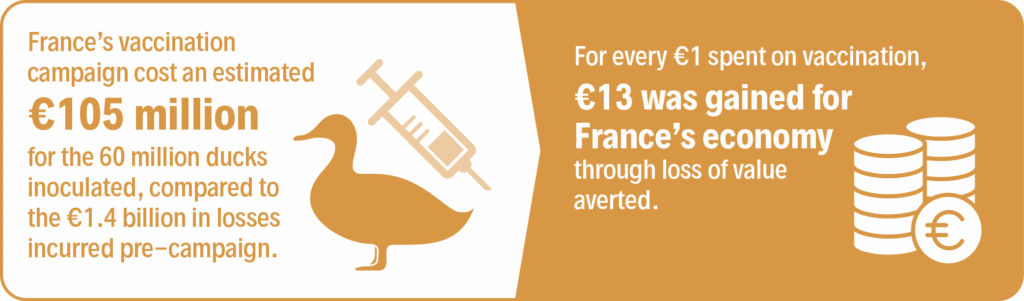
Oxford Analytica modelled cumulative losses in poultry meat production due to HPAI outbreaks in France. Vaccination together with traditional disease control measures, including, surveillance, early detection, quarantine, and movement restrictions were associated with a lower estimated loss of life.

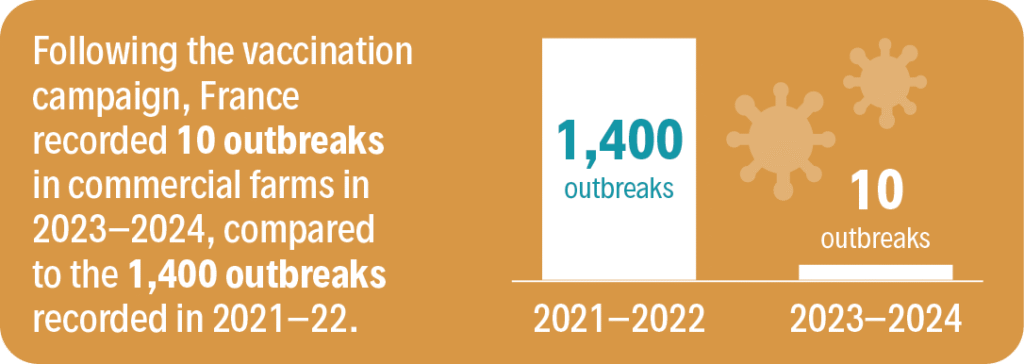
As an important animal health tool, vaccination can signify overall improvement in animal care, increased productivity for farmers, and decreased food losses.
- The modelling finds that increasing the vaccination rate for broilers from a baseline vaccination rate (20%) to 50%, reduces the estimated loss of life by one third.
- This prevented food loss translates to the ability to serve three-quarters of the France population (67.8 million people) a serving of chicken.
- Given that the cost of whole broiler meat was EUR 2.2/Kg in France in 2021, reducing this food loss would result in an estimated savings of EUR 16.7 million.
Promoting disease prevention for increased sustainability in livestock farming
Promoting sustainability in livestock production through increased disease prevention is critical.
Healthy animals produce animal-sourced foods – such as milk, eggs, fish and meat – more sustainably by requiring less resource inputs to maintain consistent yields. This helps to reduce greenhouse gas (GHG) emissions, decrease food and animal losses, and increase efficiency and sustainability.
Overall improvements to animal health are intrinsic to promoting resilience and sustainability throughout the livestock production value chain within the agricultural economy, while also supporting broader social goods.