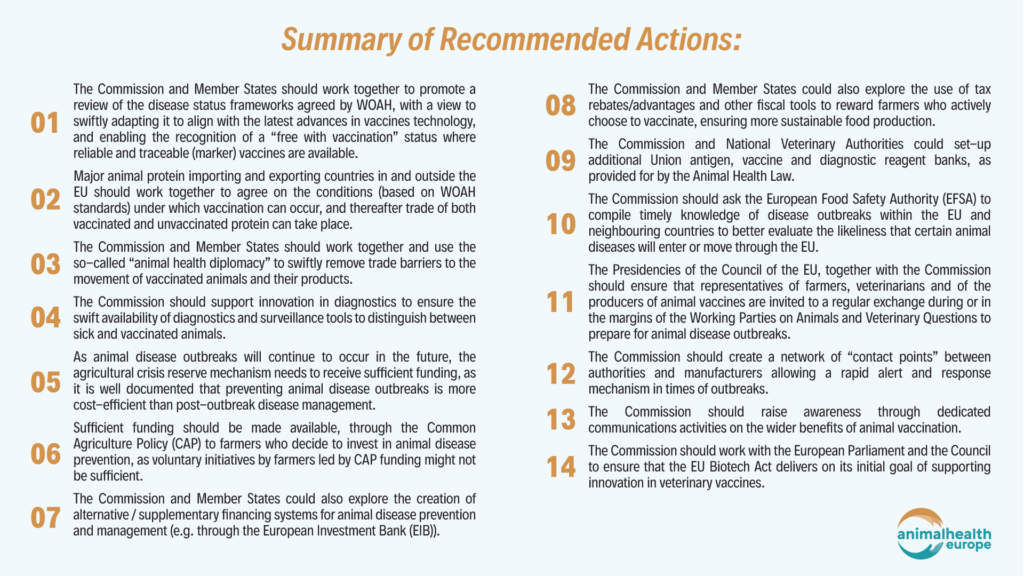
14 Key Actions for an EU Animal Vaccination Strategy
Transboundary and emerging animal diseases have been increasing in occurrence over the past few decades. Diseases which were once only reported outside of Europe’s borders are now more frequently occurring on European soil, and not solely in the continent’s southern climes. Relying on the reactive approach may not be the best strategy to protect Europe’s animals – and maybe even our human population – from the next, inevitable disease outbreak. We need a fundamental shift from a “firefighting” approach to a “fire prevention” approach. Otherwise, the consequences of a future outbreak could spiral beyond our control, dealing a serious blow to European agriculture, public health, and the wider economy.
Although vaccination alone cannot protect all livestock species against every disease that may potentially affect animals in Europe, it remains an essential component of animal disease preparedness, alongside strong biosecurity measures. Animal vaccination also helps address citizens’ concerns, particularly regarding large-scale culling and animal welfare. At the same time, harmonising animal vaccination across Europe is a complex and multifaceted issue, requiring the development of a specific, EU-harmonised strategy. Currently there are different approaches towards vaccination, between Member States, and others, sometimes even between regions in one country. This weakens the internal market as farmers and their animals are treated differently, based on the national or regional authority they depend on.
The EU has taken important steps through the Animal Health Law (EU Regulation 2016/429) in providing a robust legal framework for managing transmissible animal diseases, but it has become clear that legislation alone cannot shield Europe from the economic and social impacts of disease outbreaks. When a new disease outbreak is serious enough to impact food production and the agricultural economy, very often veterinary medicines manufacturers are contacted with the request to rapidly deliver vaccines. However, when authorities send urgent requests for a vaccine to be developed and supplied only after the emergence of an outbreak, and when use of the vaccine is not guaranteed, the need for at least minimal supply planning, as well as the time needed for vaccine development make it very difficult or even physically impossible for companies to act within the required timeframe to immediately respond to the request. An earlier and regular, data-supported exchange would significantly help to remediate this often slow and reactive approach.
The elements outlined in our paper are suggestions from AnimalhealthEurope as to how a harmonised EU Animal Vaccination Strategy could take shape.